


The 6 Basic States of Consciousness: A Quick Guide to the Mind’s 6 out of many Modes
Consciousness is one of the most fascinating and mysterious aspects of being human. It’s the ever-shifting stage where thoughts, sensations, dreams, and awareness play out—but it’s not just one fixed state. Our consciousness moves through several distinct modes, each with its own characteristics and purpose.
Whether you’re deep in thought, drifting in a dream, or lost in a meditative flow, you’re experiencing a different state of consciousness. Let’s explore the fundamental states that make up this inner landscape:
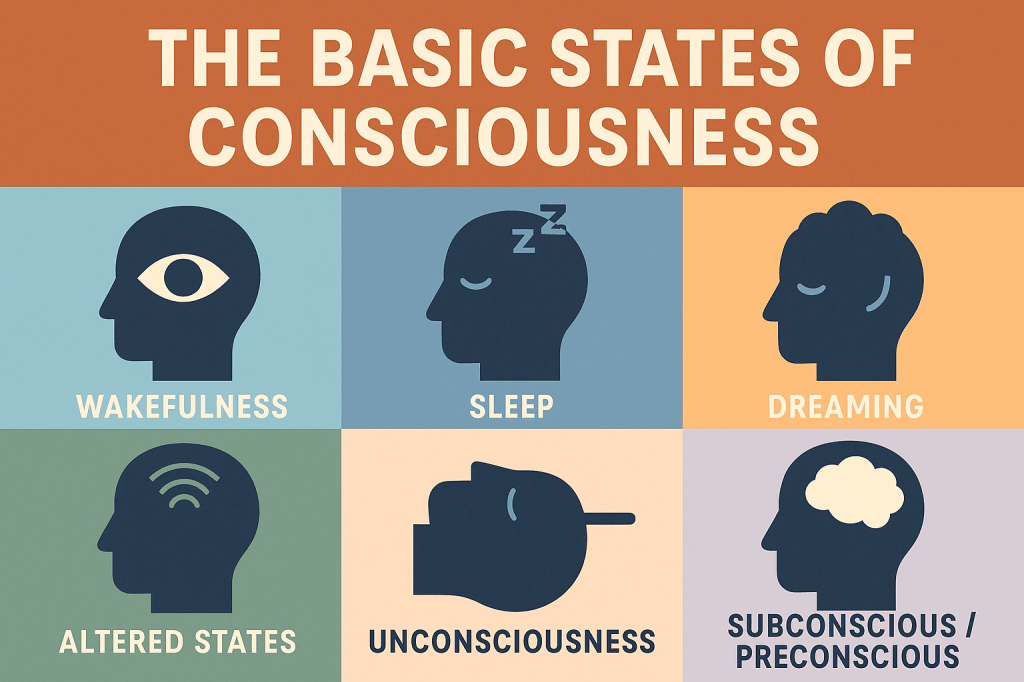
1. Wakefulness: Conscious Awareness
This is the state we’re most familiar with—being awake, alert, and aware. In this mode, we interact with the world, think critically, respond to stimuli, and reflect on ourselves.
Even within wakefulness, there’s a spectrum:
Focused attention, like when you’re reading these words or solving a puzzle.
Mind-wandering or daydreaming, when your thoughts drift freely.
Flow state, where you’re fully immersed in an activity and lose track of time.
2. Sleep: The Offline Reset
Sleep is essential, but it’s not a single block of unconsciousness. It’s a complex cycle with multiple layers:
Non-REM Sleep: Divided into light and deep stages. As you descend deeper, your brain slows down and bodily repair begins.
REM Sleep: The brain becomes active again, similar to wakefulness, but your body is temporarily paralyzed. This is when most dreaming happens.
Sleep is your brain’s way of decluttering, filing memories, and restoring energy.
3. Dreaming: The Inner Theater
Dreaming—especially vivid, story-like dreams—typically occurs during REM sleep. You’re unaware of the physical world but immersed in a mental one. In this state:
Time and logic may behave strangely.
Emotions and symbols dominate.
Sometimes, people become lucid, realizing they’re dreaming and gaining some control over the dream.
4. Altered States: Beyond the Norm
These are states that differ markedly from everyday wakefulness. They can be entered intentionally or spontaneously:
Meditation and trance: Often calm, focused, and inwardly directed.
Hypnosis: A state of suggestibility and focused attention.
Psychedelic states: Triggered by substances or intense spiritual practices.
Flow states: A deep focus during creative or athletic activities.
These states often bring insight, emotional release, or altered perceptions of time and self.
5. Unconsciousness: The Lights Are Out
In this state, awareness is absent. This can occur from:
Anesthesia
Severe brain injury or coma
Fainting or blackout
Though the mind is not actively conscious, the brain may still perform basic life-supporting functions.
6. The Subconscious & Preconscious: Behind the Curtain
Though not always classified as full “states,” these layers of consciousness operate beneath active awareness:
Subconscious processes guide habits, memories, and reactions.
Preconscious thoughts are not currently in your awareness but can be recalled easily.
They shape behavior and perception in subtle but powerful ways.
so
Understanding the basic states of consciousness helps us appreciate the full range of human experience—from the logical mind of daytime to the surreal stories of our dreams, and everything in between. These shifts in awareness aren’t just random; they serve vital roles in survival, creativity, healing, and insight.
Exploring them mindfully—through sleep, meditation, or even simply observing your thoughts—can open doors to a deeper relationship with your own mind.
Subscribe.
Until next time.
 Redominatelife
Leave a comment